Charles Murray House "Rostrevor"
403 St. George Street • Victorian Queen Ann • Built 1889 • Architect: Samuel Maclure and Charles H. Clow • Builder: Robert Brown Bell
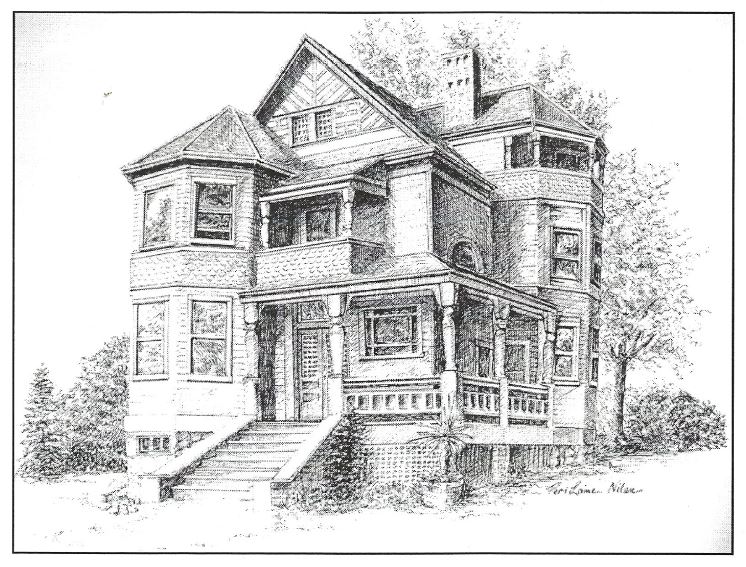
A showcase of Victorian design, “Rostrevor” is one of Queen’s Park’s grandest and most storied heritage homes. From art glass windows and hidden cedar pocket doors to decades of restoration work, the house reflects both extraordinary craftsmanship and remarkable resilience.
This landmark Queen’s Park residence was built in 1890 during the early development of the neighbourhood, shortly after streetcar service connected Queen’s Park to downtown New Westminster and encouraged the construction of grand Victorian homes along its landscaped streets. Designed by renowned local architect Samuel Maclure and his partner Charles H. Clow for decorator and artist Charles Murray, the house is a superb example of the Victorian Queen Anne Revival style.
Inspired by a house design published in the August 1888 edition of Scientific American, Architects & Builders Edition, the residence features picturesque asymmetrical massing, complex rooflines, projecting bays, and richly textured exterior detailing. Constructed at a cost of $5,000 by contractor Robert Brown Bell -- who later became a prominent architect in Vernon, BC -- the home incorporated imported walnut fireplace mantels, English tiles, and a native BC maple staircase manufactured in New Westminster.
The beautiful art glass windows are among the oldest surviving examples of Bloomfield glass, created shortly after Henry Bloomfield and Sons established the first art glass studio in Western Canada in New Westminster in 1890. Particularly notable is the “Crazy Quilt” window in the inglenook beneath the hall stairs, created from leftover shards of coloured glass from the larger windows.
The Gilley Years
Murray was forced to sell the home during the economic depression of the 1890s. In 1901, it was purchased by Walter R. Gilley, a successful lumberman originally from St. Andrews, New Brunswick, whose family business evolved into the well-known Gilley Brothers contracting and supply firm. Gilley renamed the house “Rostrevor” and, in 1914, undertook renovations intended to give the exterior the appearance of an Arts and Crafts-style mansion.
The Gilley family owned the home until 1961, when it was converted into apartments and heavily altered, including extensive stuccoing inside and out. The house was eventually rescued by local residents Steve Norman and Kitty O’Callaghan.
A Remarkable Restoration
Subsequent owner Joaquim Ayala embarked on an ambitious restoration project, removing the stucco, reconstructing the roof and chimneys, and restoring period features including scalloped shingles, Tudor half-timbering, veranda posts, and extensive interior moldings. Hidden architectural treasures, including massive cedar pocket doors concealed behind drywall, were also uncovered and restored.
The current owner (as of 2004) completed the final phase of restoration, creating a more livable family-oriented interior with a new kitchen and reconfigured dining and family spaces. New landscaping, patios, and a garage complement the property, while the owner’s extensive collection of antiques and furnishings beautifully enhances this remarkable Royal City residence.