James and Emma (Chubb) Loree House
327 Fifth Street • Arts and Crafts • Built 1931
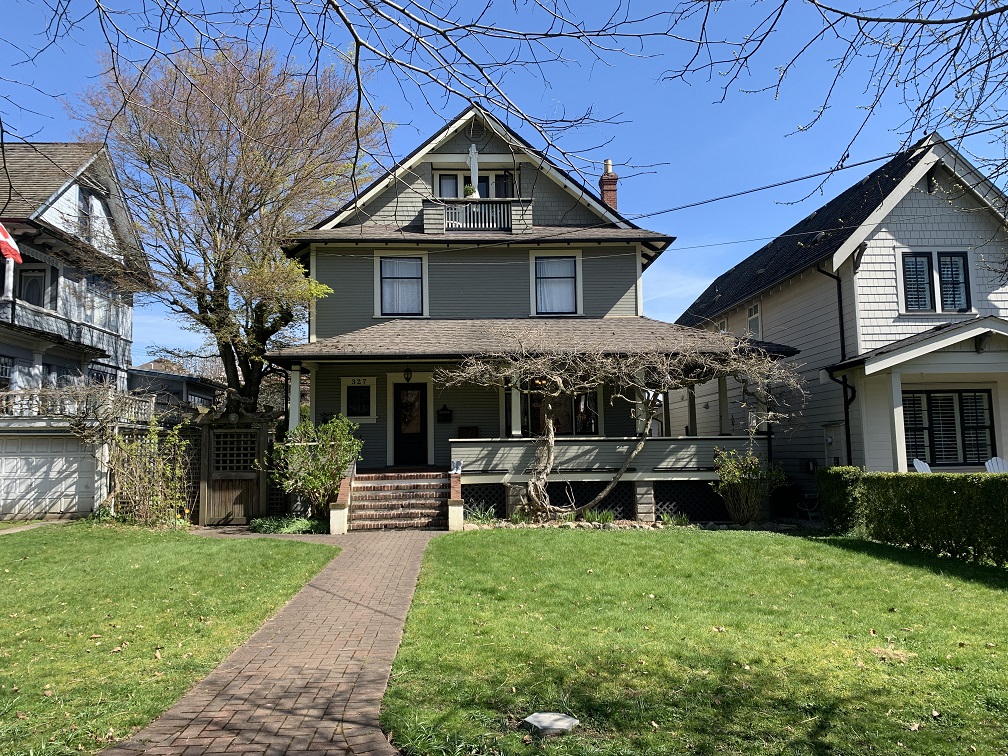
A home shaped by pioneers, physicians, and generations of family life. This residence reflects a story of movement, service, and continuity in New Westminster. An enduring home with a layered and evolving past.
Built in 1910 for James C. Loree and his wife, Emma Jane (Chubb), this home reflects the early development of New Westminster during a period of transition and growth. Loree, born in Guelph, Ontario in 1850, lived a life shaped by westward movement and perseverance. After years in Manitoba and Alberta—where he and his wife were among early settlers—they arrived in New Westminster and built this house as part of a new chapter.
Records indicate a water connection for the property in July 1910, though the original builder is unknown. By 1915, the Lorees had returned to Alberta, where they continued farming before settling again in Nanton.
By 1918, the house had come into the possession of Dr. James Gordon McKay and his wife, Florence. Dr. McKay, a psychiatrist educated at McGill University, was associated with two of British Columbia’s most significant early mental health institutions: Woodlands in New Westminster and Essondale (later Riverview Hospital) in Coquitlam. He also operated the Hollywood Sanatorium, opened in 1919 for the treatment of tuberculosis—later known for treating high-profile patients.
Dr. McKay was also the owner of the Hollywood Sanatorium, established in 1919 for the treatment of tuberculosis patients. Despite what the name might suggest today, “Hollywood” did not refer to the film industry or celebrity culture. Rather, it was derived from the holly trees that grew on the property—an evocative, nature-based naming convention typical of the time. In the early 20th century, sanatoria were often set in tranquil, landscaped environments, where fresh air, rest, and nutrition were considered essential to recovery. The name “Hollywood” would only later take on different cultural associations, but in this context, it reflects a quieter, almost pastoral origin tied to the landscape itself.
The McKay family remained in the home for decades, with ownership extending through successive generations until 1991. The longest-term resident of the later years, Jean Isobel Thomson, lived in the house into her late nineties, underscoring the home’s deep family continuity.
Architecturally, the house reflects an Eclectic Period style with strong Arts and Crafts and Edwardian influences. Its gable-on-hip roof, balcony set within the gable, and combination of clapboard and shingle siding create a distinctive profile. A broad front porch, supported by substantial brickwork, adds a grounded, welcoming presence.
Other defining features include large double-hung windows, exposed rafter ends, and subtle Japanese-inspired detailing at the roofline—elements characteristic of early 20th-century residential design.
After 1991, the house was briefly divided into suites before being returned to a single-family home. Today, it remains a compelling example of layered history—shaped by early pioneers, long-term family ownership, and evolving architectural influences.
A notable tenant
In the later years of its history, the house was also home to noted concert photographer Dee Lippingwell, who lived here up until 1991. Lippingwell built a remarkable career spanning more than five decades, photographing thousands of concerts and capturing some of the biggest names in music. Working in what was then a largely male-dominated field, she earned a reputation for her determination and distinctive eye. Her work, which included images of artists such as Mick Jagger and Bob Dylan, was widely published and exhibited, and she later produced several photography books. Her connection to the house adds a more recent cultural chapter to its long and varied history.
Sources: City of New Westminster Archives, The Georgia Straight, and research by Bozana Djuric