John S. and Martha Hainsworth House
729 Queens Avenue • Arts and Crafts • Built 1912 • Architect: James Boulton Whitburn • Builder: Harold Disney and Bertram Ewart Tucker
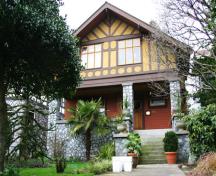
John Slater Hainsworth was born in Bradford, Yorkshire, in 1854. By chance, he met Henry Morey, the son of a New Westminster Royal Engineer, who was travelling through England on his way to study music in Leipzig, Germany. The two young men became friends, and in 1886 Hainsworth and his wife, Martha Ann, decided to travel to New Westminster. Hainsworth joined Morey as manager of H. Morey & Son, printers and stationers.
The business was destroyed in the Great Fire of 1898, but the partners rebuilt and resumed operations. They also reconstructed their neighbouring homes on Eighth Street below Royal Avenue, which had also been lost in the fire.
In 1912, the Hainsworths commissioned young architect James Boulton Whitburn to design a new residence reflecting their status and prosperity. In this, his first residential commission, Whitburn incorporated the latest Arts and Crafts design principles, using local natural materials and modern construction techniques.
The resulting one-and-one-half storey, Arts and Crafts-style wood-frame residence sits on the north side of Queen’s Avenue in New Westminster’s historic Uptown neighbourhood. The house features a cross-gabled roof, extensive half-timbering, and a full-width open front verandah with stone balustrades and piers. The stucco used on the exterior was among the first locally to be applied to wire mesh rather than traditional wooden lath.
Whitburn went on to become one of the city’s most notable architects and served for many years as architect to New Westminster School District 40. His work included Richard McBride School in Sapperton and the former Trapp Technical School on Eighth Street (now John Robson School), which is visible from the front verandah of Hainsworth House.
The granite foundation and verandah create a welcoming entrance to the home. Wood shingles on the roof and walls are complemented by gabled rooflines and exposed beams. A popular Arts and Crafts motif inspired by medieval design is seen in the half-timbered gable, while the many stained-glass windows incorporate natural plant motifs. Interior cabinets and room separations showcase fine craftsmanship in both wood cabinetry and millwork. This openness is balanced by generous use of wood panelling, ceiling beams, and detailed fireplace surrounds.
This home exemplifies the Arts and Crafts aesthetic, which emphasized simplicity, craftsmanship, and honesty in design. influenced by William Morris, an English textile designer, poet, artist, writer, and socialist activist associated with the British Arts and Crafts movement, emerged as a reaction to the heavy ornamentation of the Victorian period. Hainsworth House remains a strong and enduring example of this style, which has remained popular for well over a century.
John S. Hainsworth and Henry Morey retired from their business in 1922. Martha Hainsworth died in 1933, and John continued to live in the house into his nineties, passing away in 1944. As with many large homes of the period, the house later became a rooming house and underwent a number of unsympathetic alterations. It was rescued by Maureen and Phaedon Arvanitidis, who restored the house and initiated its designation as a City heritage site in 1986.
The current owners have continued this stewardship, undertaking careful updates to furnishings and lighting in keeping with the Arts and Crafts style. They have also created gardens that restore the setting and enhance this landmark Royal City home.
Additional Information from: Canada's Historic Places Statement of Significance: Hainsworth Place
Character-Defining Elements
Key elements that define the heritage character of the Hainsworth Residence include its:
- location on the north side of Queen’s Avenue in the historic Uptown neighbourhood in New Westminster, in a
historic residential setting
- residential form, scale and massing, as expressed by its one-and-one-half storey height plus basement, cross-
gabled roof, full-width open front verandah, and side projecting semi-octagonal bays
- construction materials, such as wood-frame construction with shingle siding on the main body, masonry rubble-
stone with raised tuck pointing used for the balustrades, stair cheeks and piers, and stucco and half-timbered cladding
- elements of the Arts and Crafts style, such as extensive half-timbering in the gable ends, scroll-cut brackets,
pointed bargeboards, and a variety of wall claddings
- windows, such as multi-paned wooden-sash casement windows with leaded glass transoms, and fixed stained glass windows
- original panelled wooden front door with glazed inset
- internal red-brick corbelled chimney
- associated landscape features, including a rough-dressed ashlar sandstone wall at the front property line