Could a Community Purchase Help Save 239 Fourth Street?
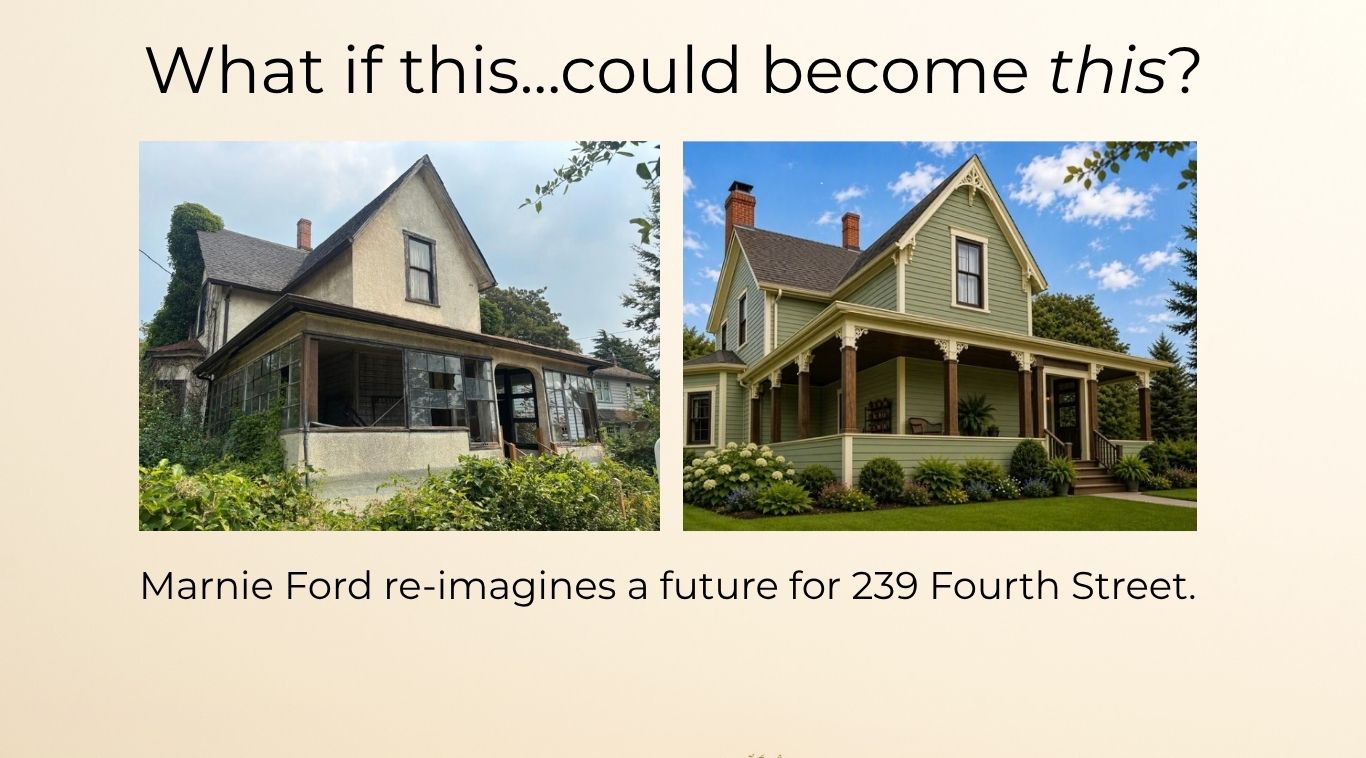
A New Westminster resident proposes a community-led approach to restoring one of the city’s historic homes.
Heritage New West is sharing the following letter from New Westminster resident Marnie Ford, who has put forward an idea for the future of 239 Fourth Street.
In her letter, Ford outlines the challenges facing the long-vacant property, as well as the heritage value identified in a 2026 heritage assessment. She proposes exploring whether a group of community members could come together to purchase, stabilize and restore the house — not primarily as an investment, but as an opportunity to save an important piece of New Westminster’s heritage.
Ford’s letter invites others who may be interested in such an approach to come together and explore whether there is enough community interest to take the idea forward.
The following letter is published as submitted by the author.
To the Heritage New West Board of Directors:
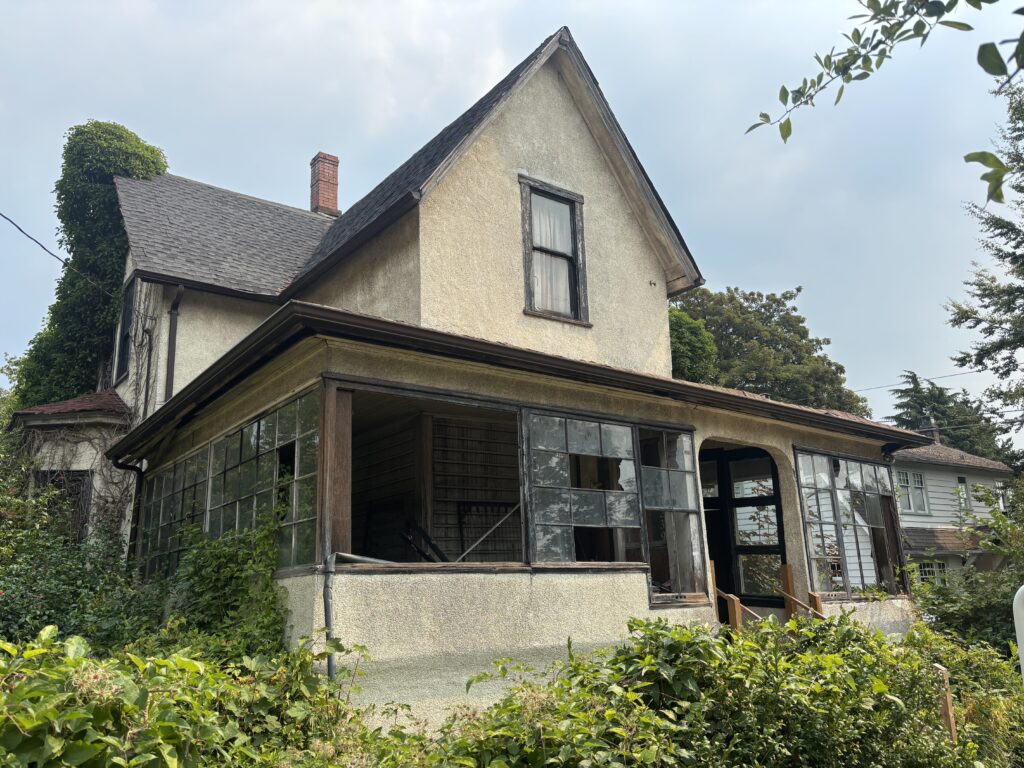
I am writing about 239 Fourth Street. Currently for sale at $1,349,000, this 1888 house is severely dilapidated and has been for many years.
The case for demolition is strong:
An April 2026 structural assessment by Ennova Structural Engineers documented significant deficiencies in the building. Their findings include evidence of settlement, deteriorated structural elements, an inadequate foundation system and an absence of code-compliant lateral-force resistance. The engineers concluded that restoration and upgrading, while technically possible, would be extensive and costly.
The case for preservation is equally compelling:
In May 2026, Luxton Heritage Consultants concluded that, despite its poor physical condition, 239 Fourth Street retains significant heritage value. Dating from 1888, its Victorian Gothic character remains clearly expressed in its overall form and design, original wraparound verandah and clapboard siding under stucco, original wood (fir?) flooring preserved under linoleum, and surviving art-glass window features dating from approximately 1901. It is one of New Westminster's oldest surviving dwellings and was once owned by Peter Latham, one of the early gardeners of Queen's Park.
In July 2026, following submission of a Heritage Alteration Permit application seeking demolition, the City of New Westminster denied the application. Its assessment found sufficient heritage merit, restoration potential and development potential to require retention of the house.
This leaves 239 Fourth Street in a difficult position: it is considered too important to demolish, yet the cost and complexity of restoring it may make conventional private ownership financially unattractive.
There are a few ways for the story of 239 Fourth Street to end. The property could remain on the market. Its price could fall. Its condition could continue to deteriorate. A future application might ultimately permit its demolition. Eventually, through time and neglect, the choices available may simply disappear.
I believe there may be another option.
239 Fourth Street is, quite literally, a diamond in the rough. She is tired. She needs considerable work. And, as anyone who has restored an old house knows, she will undoubtedly hold a few surprises.But underneath more than a century of wear remains an extraordinary old New Westminster home waiting for someone to see what she could be again.
What if a group of like-minded people came together to purchase and restore 239 Fourth Street?
I would personally like to be one of them.
I would be prepared to participate financially in such a group, and I suspect there may be others in our community who would as well. The concept need not be complicated. Participants would pool sufficient capital to purchase, stabilize and restore the property. The project could potentially be undertaken without conventional mortgage financing, thereby reducing carrying costs while the restoration is underway. When the restored house is eventually sold, the proceeds would first be used to satisfy the project’s obligations and return the participants' contributed capital, to the extent possible. Any remaining net profit — or any shortfall — would then be shared among the participants according to their respective interests in the project.
If everyone contributed equally, those interests could simply be equal. If contributions differed, participation in the financial outcome could be proportionate to the amount each member contributed. The hope, of course, would be that participants ultimately recover all, or very nearly all, of the money they put into the project. Depending upon the acquisition price, restoration costs and eventual sale price, there could even be a financial return. Equally, everyone involved would need to understand from the outset that there is risk and that a modest loss is possible.
The distinction is important: We would not be doing this primarily to make money. We would be doing it to save the house.
And, if such model of community-led restoration were successful, perhaps it could someday be used again when another important heritage property finds itself caught between the value of preservation and the economics of restoration.
At this stage, I think the more important question is simply:
Are there enough of us who would like to save 239 Fourth Street to find a way to do it?
I would welcome the opportunity to meet with anyone interested to discuss the idea and determine whether there is sufficient interest to take the next step.
Thank you for considering this proposal, and for the work you already do to ensure that New Westminster's past remains a visible part of its future.
Sincerely,
Marnie Ford